
Editorial Feature
Valentine’s Day
At The Alchemical Art, we are interested not only in how artists create, but in how art situates itself within deeper cultural and psychological histories.
As part of our evolving editorial series, we invited visual artist and exhibition essayist Annita Apostolidou Platis to reflect on love beyond cliché and commerce — beyond the performance of Valentine’s Day — and instead through the lens of art history, symbolism, and psychological depth.
Beyond Valentine: Reclaiming Love Through Art explores how artists across centuries have wrestled with love as ritual, attachment, projection, fracture, and attention.
Beyond Valentine: Reclaiming Love Through Art
by Annita Apostolidou Platis
The origins of Valentine’s Day themselves are blurred, layered, uncertain — much like love.
Historians often trace its distant echoes back to the Roman festival of Lupercalia. Later, the Church
attempted to soften these excesses by sanctifying the date through the figure of Saint Valentine.
What matters is not which version is “true,” but that love was once understood as something
powerful enough to require ritual, myth, and containment.
It was only centuries later, through poetry rather than doctrine, that love found its romantic voice.
When Geoffrey Chaucer wrote Parliament of Fowls in the 14th century, he linked Valentine’s Day to
the moment birds choose their mates — an image that shifted love from obligation to inclination,
from fate to desire. From that moment on, love began its slow transformation into choice.
Art has followed that transformation closely.
Across centuries, artists have returned obsessively to the image of lovers — not because love is
simple, but because it is unstable. Love resists definition. It is both union and fracture, presence and
absence, promise and devotion, even fear. In art, love becomes a space where contradictions can
coexist.
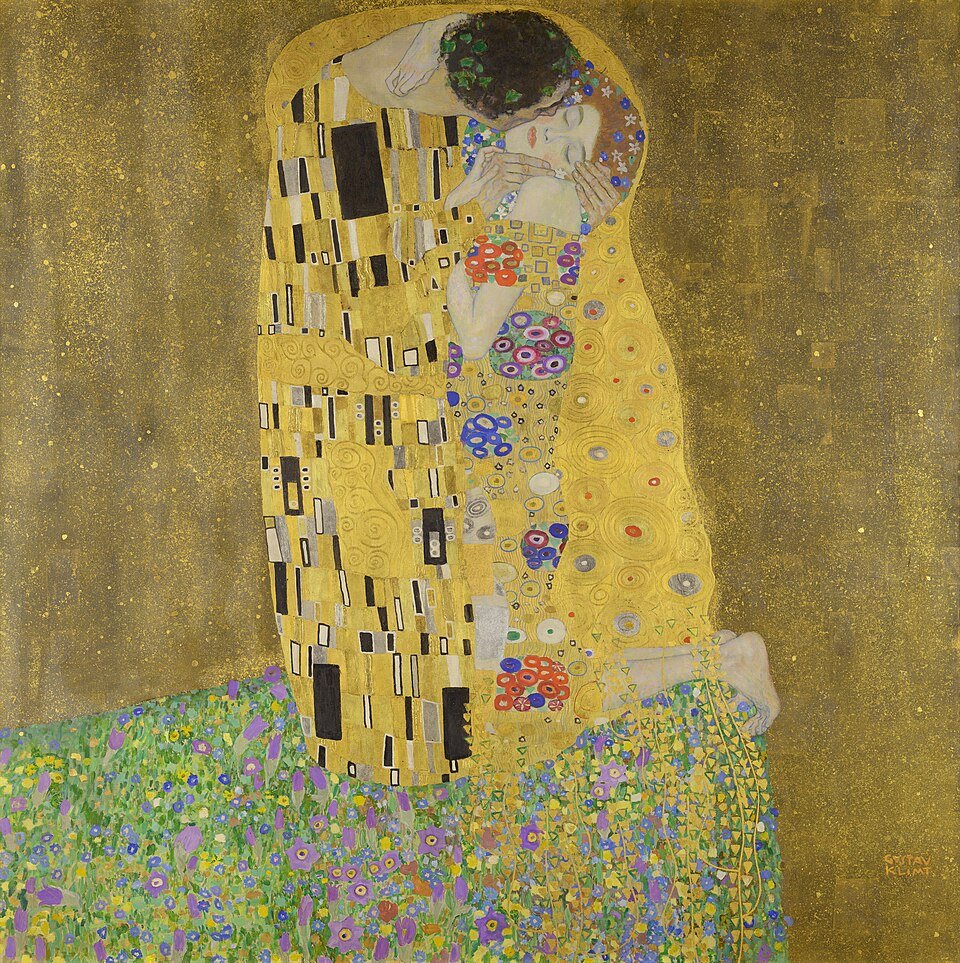
Few images express this tension more vividly than The Kiss by Gustav Klimt. Wrapped in gold leaf,
the couple appears suspended outside time, fused into ornament and pattern. Yet the woman’s
posture is inward, almost meditative. Her eyes are closed not in surrender, but in interiority. Klimt’s
lovers are sealed within their own world. Psychologically, this reflects a modern shift: love as interior
experience rather than social contract.
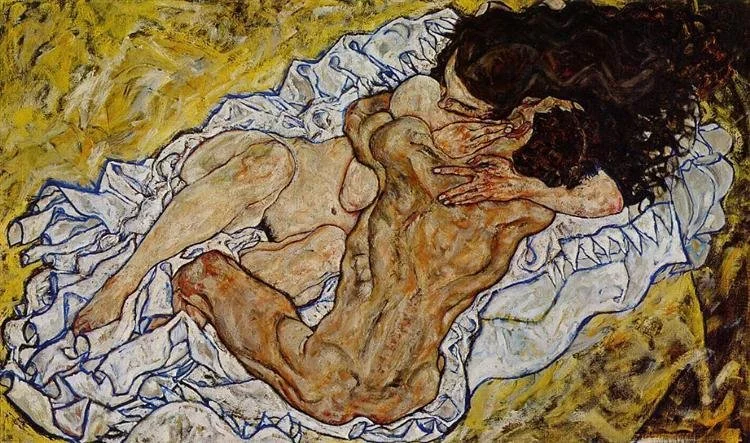
By contrast, love in the work of Egon Schiele is raw, exposed, almost uncomfortable. His embracing
figures cling rather than merge, their bodies tense, their intimacy edged with fear. Schiele does not
idealize connection; he exposes its urgency. Love here is attachment stripped bare — a psychological
need as much as an emotional one.
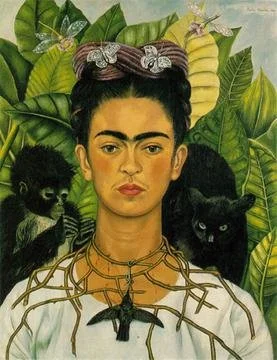
This tension between tenderness and fracture deepens in the life and work of Frida Kahlo. Kahlo’s
love was inseparable from pain, identity, and survival. Her bond with Diego Rivera was neither
romanticized nor resolved. Instead, it became a site of transformation. In her self-portraits, love
does not heal the wound — it reveals it. Psychologically, Kahlo speaks to the resilience of selfhood
within attachment: love as a force that reshapes without erasing the individual.
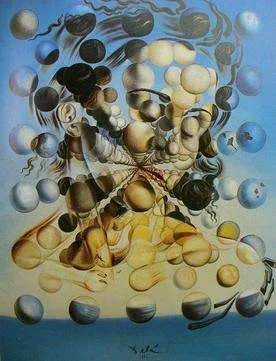
If Kahlo exposes love’s endurance, Salvador Dalí dissolves it into obsession and myth. His devotion to
Gala was not grounded in realism, but in projection. In Dalí’s universe, love bends reality, distorts
time, and feeds the unconscious. Desire is not rational; it is symbolic. From a psychological
perspective, Dalí reminds us that love often functions less as connection and more as mirror —
reflecting longing, fantasy, and fear.
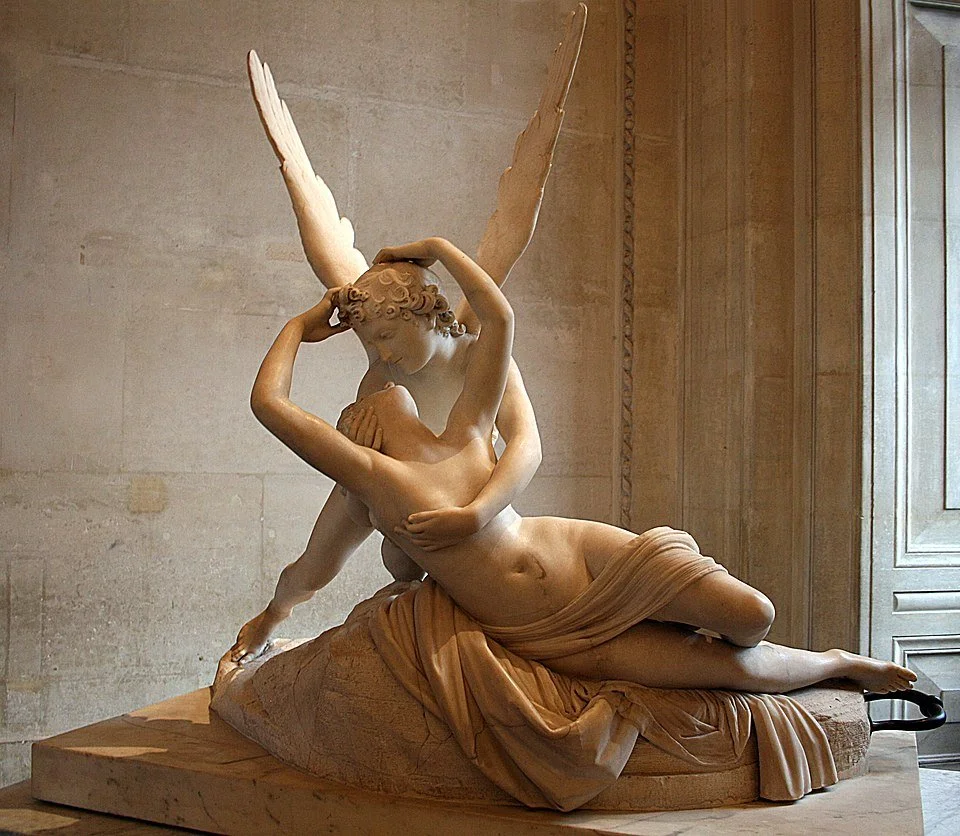
Sculpture, too, has captured love at its most fragile threshold. In Psyche Revived by Cupid’s Kiss,
Antonio Canova freezes the moment just before awakening. The bodies do not yet move; they
hover. This suspended intimacy speaks psychologically to love as transition — the instant where
vulnerability becomes trust.
Long before European Romanticism, tenderness was carved into permanence in ancient Egypt. The
statue of Horemheb and his wife Amenia (c. 1300–1250 BCE) shows the queen holding her
husband’s hand in both of hers — an unusually intimate gesture for royal sculpture. This is not
allegory; it is lived affection immortalized in stone. Love here is companionship.
Photography later captured love as fleeting truth. When Robert Doisneau photographed a kiss in the
streets of Paris, he framed love as interruption — a pause in the flow of life. Similarly, Alfred
Eisenstaedt’s Times Square kiss froze a moment of collective relief, where intimacy erupted in public
space. In both cases, love appears not staged, but accidental — something that happens when
defenses fall.
Across cultures and centuries, the message is consistent: love is not one thing. It is ritual and
rebellion, intimacy and exposure, myth and psychology.
Contemporary psychology often frames love through attachment theory and emotional regulation.
These perspectives illuminate how we bond, how we protect ourselves, how we seek security. Yet
art reminds us of something deeper: love cannot be reduced to function. It is not merely a behavior.
It is an experience that reshapes perception.
Perhaps what contemporary culture needs is not louder declarations of love, but greater
attentiveness to it. To reclaim love not as performance, but as presence. Not as spectacle, but as
sustained awareness.
Beyond Valentine’s Day, art offers us a quieter truth: love is not about perfection. It is about
attention. It’s about listening.
And maybe that is the most enduring act of love of all.
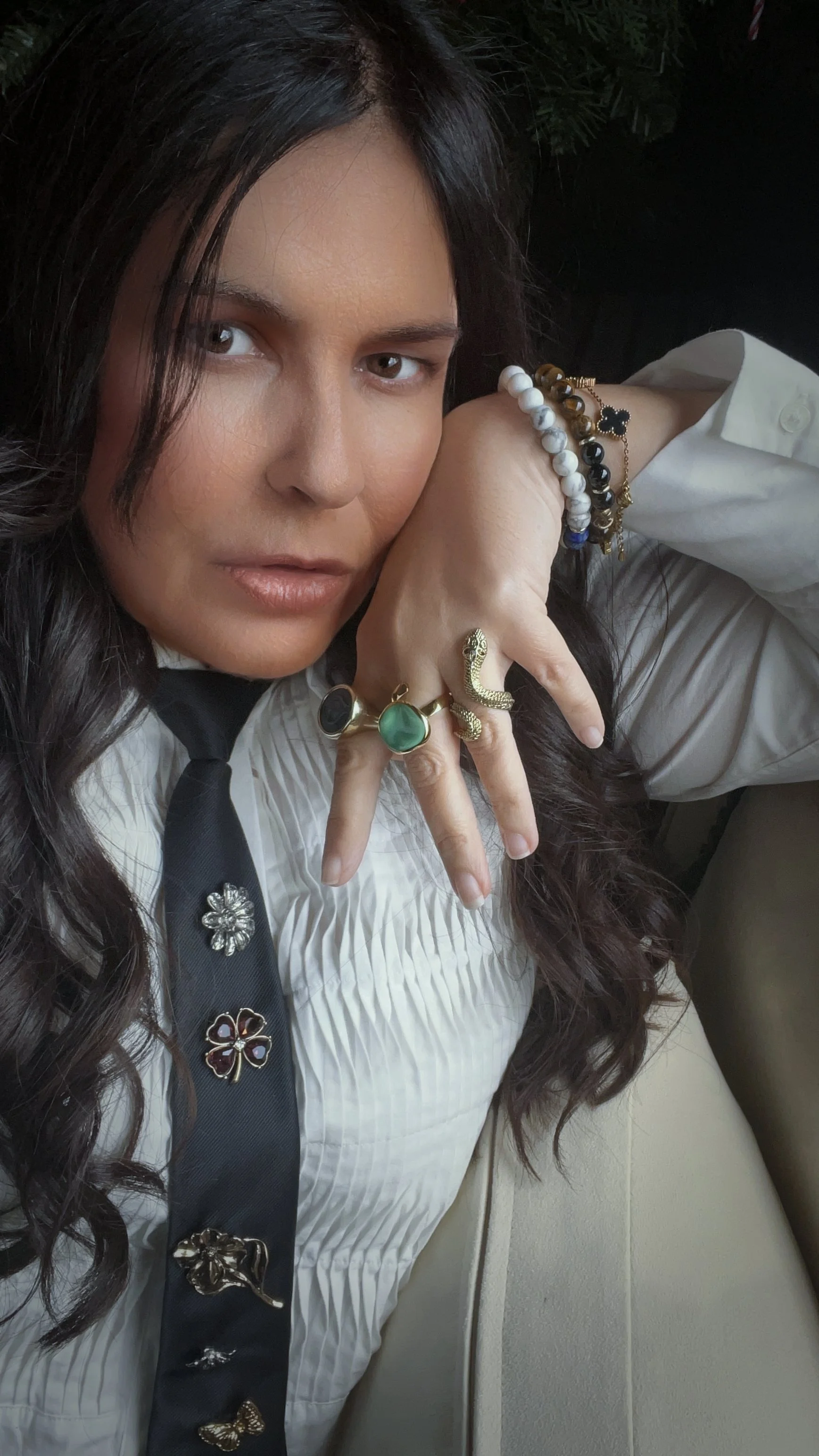
Written by Annita Apostolidou Platis
Visual Artist | Exhibition Essayist | Curator | Writer | Poet | Fashion & Jewelry Designer

To learn more about the author, visit www.annitaplatis.com
Continuing the Dialogue
At The Alchemical Art, we believe artists benefit from understanding not only how to create, but how their work sits within broader cultural, psychological, and historical discourse.
If your practice engages with themes of identity, ritual, symbolism, or emotional depth, submissions for our upcoming exhibition are now open here and our magazine submissions are open here.
We also encourage artists to approach their year with intention — aligning creative development with strategic growth. Explore our artist workbook designed to support exactly that process and make 2026 an incredible year.
→ View Current Exhibition Portal
→ Submit Your Work to Our Virtual Exhibitions
→ Submit Your Work to Our Magazine
→ Explore the Artist Workbook