
Bianca Raquel de Toledo | Interview
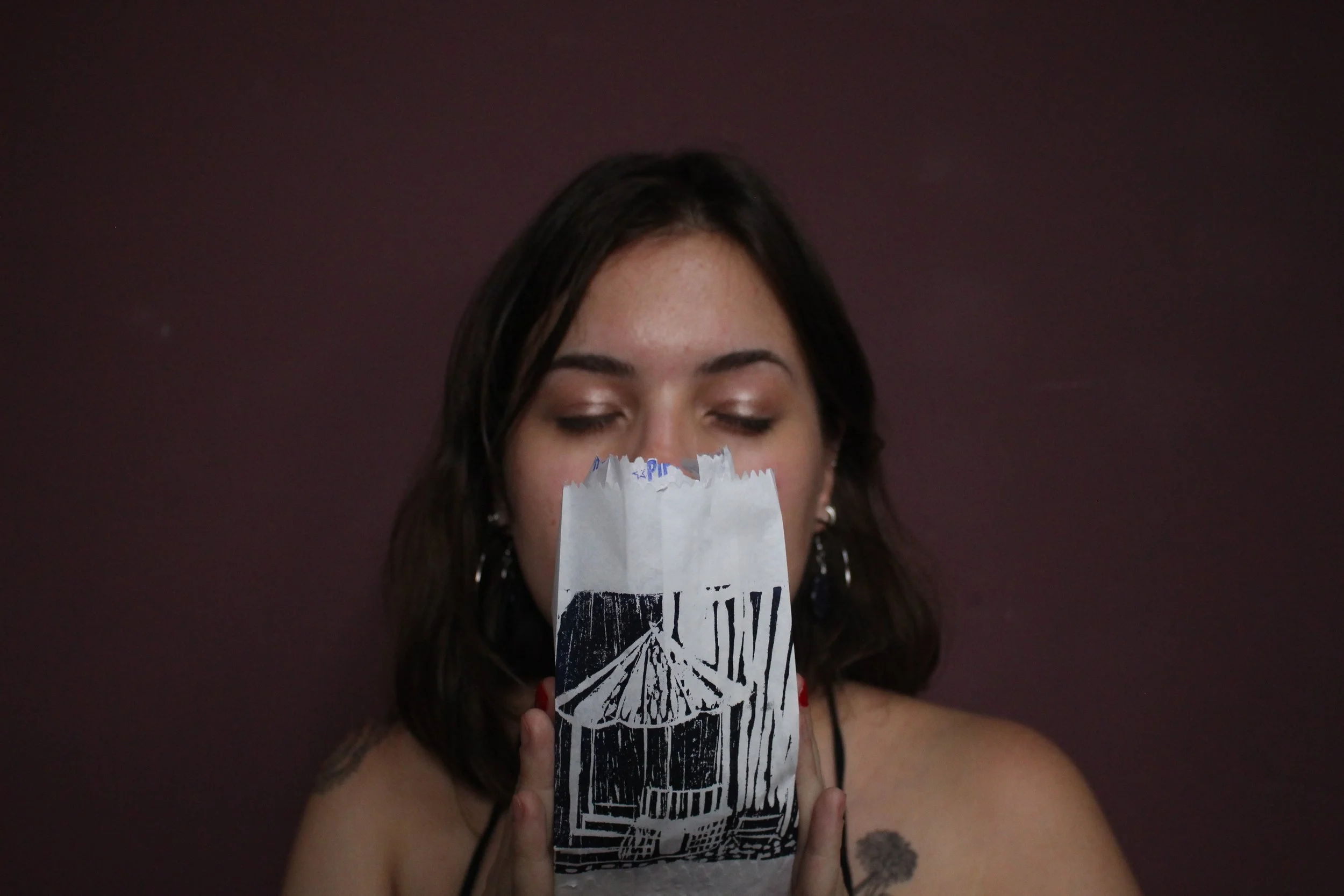
Pictured: Artist Bianca Raquel de Toledo
“I would like the audience, when encountering my work, to be able to think about their own memories and about the stories they have received from other people. Perhaps a photograph, an object, or a small memory can also awaken something that seemed forgotten and, through that encounter, acquire a new meaning.
I would like my work to open up a space for imagination — a space in which we can think about the fact that what we inherit from the past does not have to remain unchanged. We can transform, care for, recreate, and, from these memories, imagine other ways of living and being together in this world.
”
Bianca Raquel de Toledo is a Brazilian visual artist, educator and researcher whose practice approaches memory as a living material capable of transformation. Currently studying Visual Arts at the University of Campinas (UNICAMP), she works across photography, collage, watercolour, embroidery, sculpture and organic processes, drawing on personal and inherited memories, childhood, care and hope.
In Somos quase semente, portraits of women become portable archives combined with preserved plants, flowers and insects. In Esperando o tempo do maracujá, lost and family photographs are transformed through contact with fungi and bacteria. In this interview, Toledo discusses the ACHO Archive, ecological interdependence, the relationship between remembering and imagining, and the value of remaining open to uncertainty.
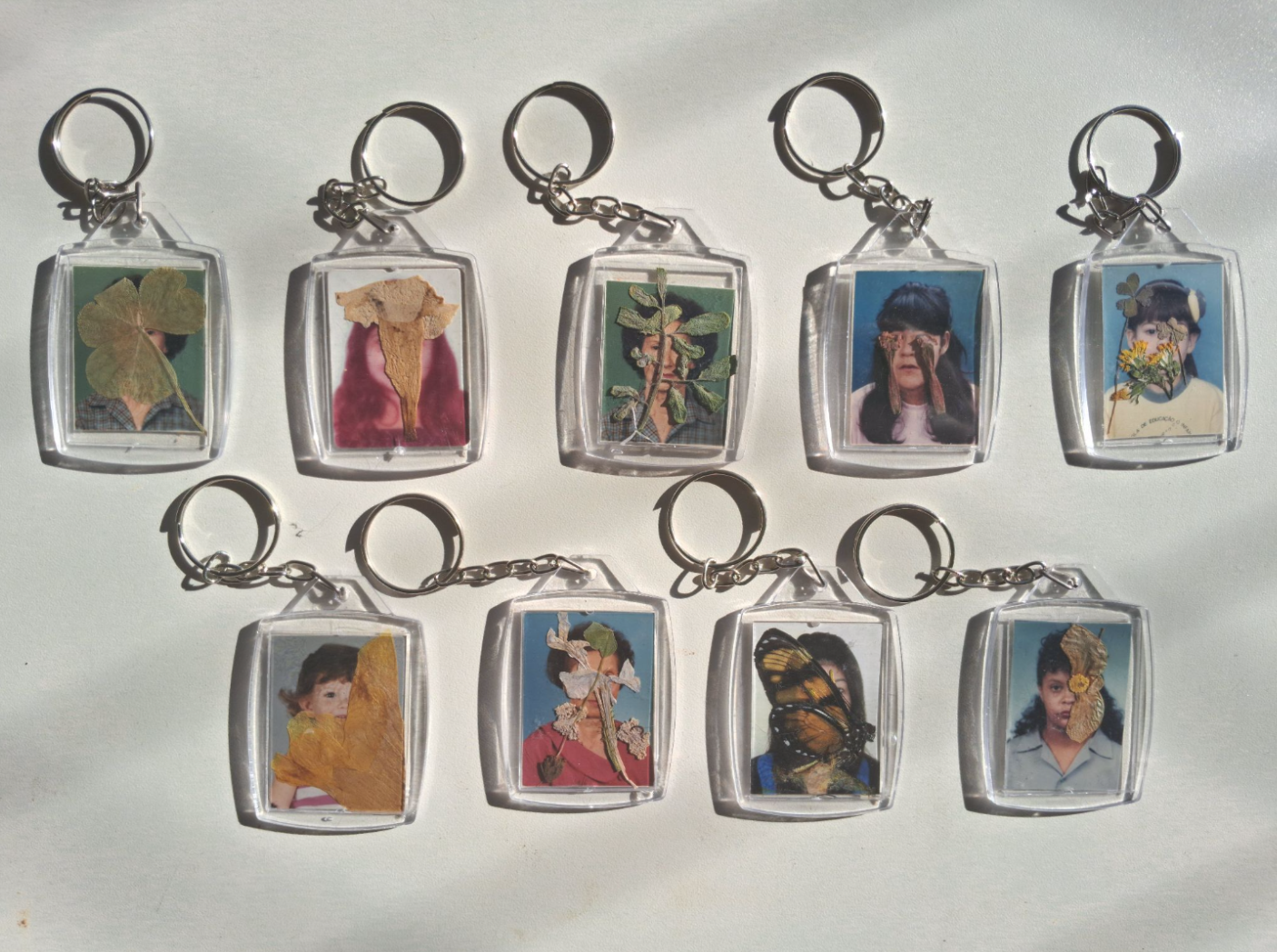
Somos quase semente (2026)
Bianca Toledo
How would you describe your artistic practice at this point in your career?
At this point in my career, I would describe my practice as an investigation into memory and its possibilities for transformation. I primarily work with photography, collage, watercolor, sculptural objects, and organic processes, exploring images and memory as materials that can be altered, crossed by, and transformed through time, encounters, and other forms of life. My practice moves between research and experimentation, bringing personal and collective experiences into dialogue with questions of childhood, care, affection, and hope.
I also consider it important to situate my practice within my experience as a Latin American woman, born and raised in the countryside of São Paulo State, Brazil. The landscapes, movements between places, forms of living together, and memories shaped in this context have deeply influenced my way of seeing. They have led me to find, in the recovery of personal and inherited memories, possibilities for creation and ways of understanding my relationship with the world and with others.
What feels most central to your work right now?
I think what is most central to my work at the moment is the idea that images and memories are mutable. I have been asking myself what happens when we stop treating a photograph as something enclosed in the past and allow it to continue living, changing, and producing new meanings, just as memories do when they are shared.
This investigation is also deeply connected to hope. How can we look at what has passed without simply trying to preserve it? How possible is it to allow new possibilities to emerge from those memories? I am interested in thinking that what has been lost, forgotten, or discarded does not necessarily disappear, but can continue to produce life and meaning in other forms.
In this sense, Anna Tsing’s The Mushroom at the End of the World has been very important to me. Her attention to forms of life that emerge in contexts of precarity, ruin, and unpredictability helps me think about memory in a different way, perhaps memory does not need to remain intact in order to survive. Like mushrooms inhabiting transformed landscapes, some images continue to produce meaning precisely because they change over time.

Pictured (above): The artist Bianca Raquel de Toledo next to their work
What themes, ideas, or questions are you currently exploring?
I have been investigating memory, childhood, archives, time, affection, and hope. I am also interested in relationships between humans and other forms of life, particularly plants and microorganisms.
When I think about these themes and questions, I believe that what best summarizes my current concerns is this: what happens when a memory is no longer understood as something we must preserve intact, but instead as something capable of growing, transforming, and generating new possibilities?
I am particularly interested in the space between remembering and inventing, between what happened and what we can still imagine. I see an important political dimension in this space, because I believe that imagining other futures can also be a form of resistance. When I work with memories, I want not only to look backward, but also to investigate how they can continue to germinate and produce other ways of being in this world.
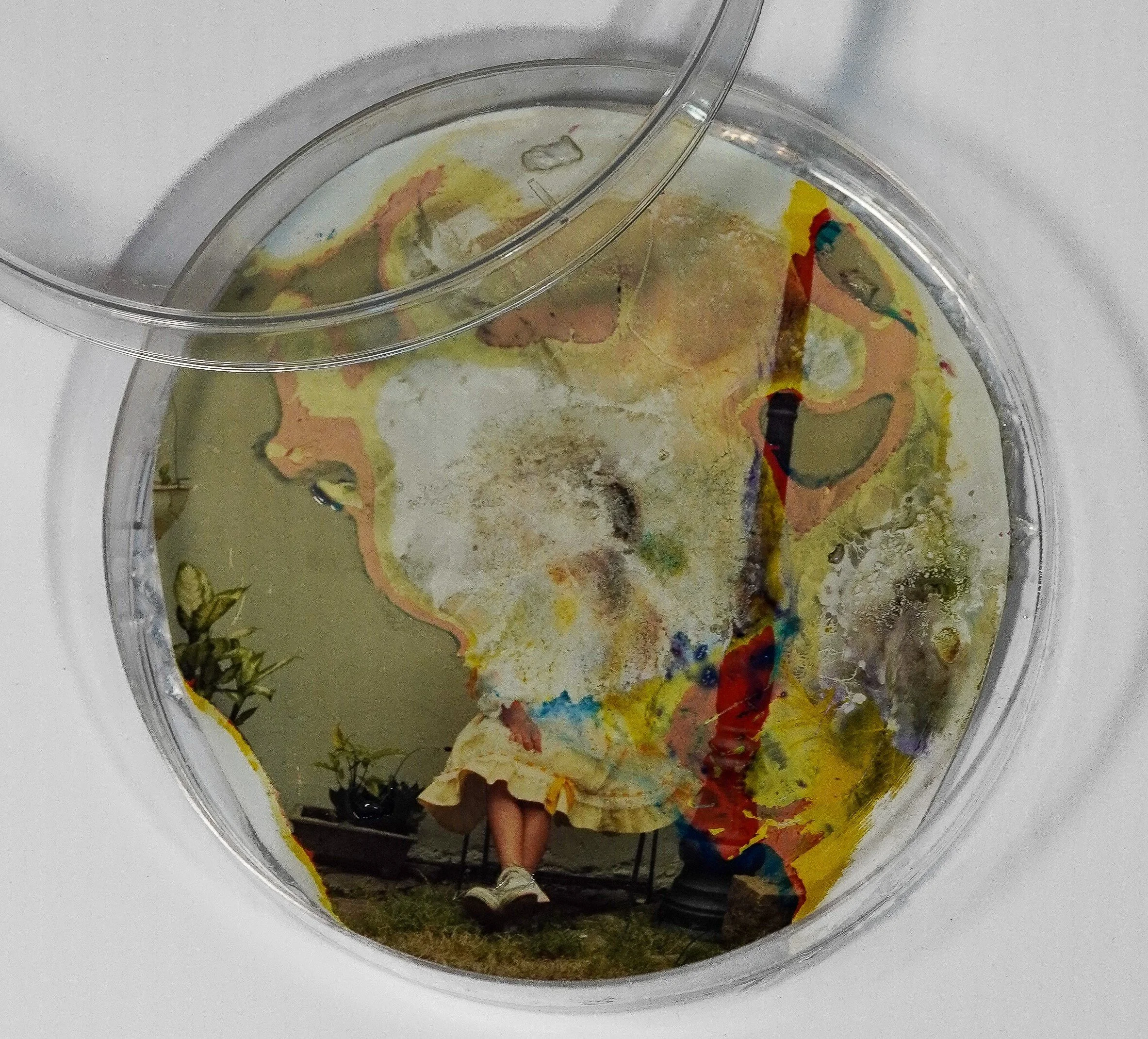
Artwork ‘Fungo 2’
Tell us about the works you are presenting with The Alchemical Art
The works I am presenting are part of a research process that investigates the transformation of photographs and the ways in which images can carry, lose, and acquire new meanings over time.
The first work, “Somos quase semente” (We are almost seed), uses 3x4 photographs of women of different ages combined with preserved organic elements. The portraits are placed inside small acrylic keychains, transforming them into archives in transit that accompany everyday movements.
The series emerged from reflections on identity, violence, resistance, and the ways in which we are continuously shaped by the experiences we live through as women. By partially concealing the women’s faces with plants, flowers, and insects, I seek to unsettle the idea of a fixed identity and to think about growth as a shared process.
The keychain is an important element of the work because it is an object designed to circulate, to be carried, and to accompany journeys. It transforms the photograph into something intimate and mobile, a small archive that remains close to the body and moves through different places. The plants take on a central role, suggesting relationships of interdependence between different forms of life. For me, these images become small seeds.
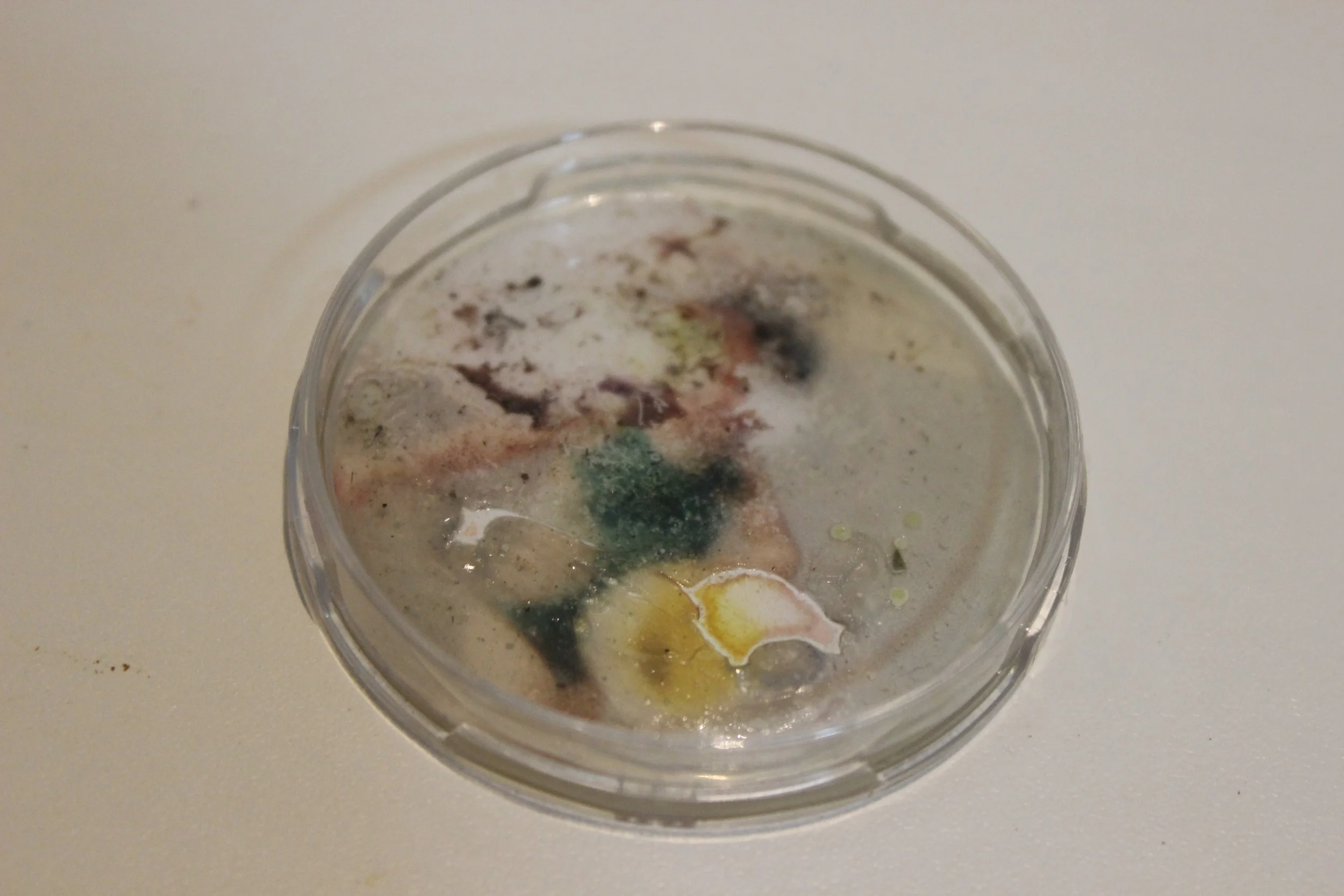
The second series, “Esperando o tempo do maracujá” (Looking forward for the passion fruit season), developed as part of my undergraduate thesis in Visual Arts at the University of Campinas (UNICAMP), investigates more directly the mutability of images and memories. In this work, I inoculate fungi and bacteria from my own body onto lost photographs and images from my family archive. I am interested in observing what happens when a photograph is understood as a living material, subject to the actions of time and other organisms.
The work materializes this reflection through Petri dishes containing photographs that have undergone these processes of transformation. After observing the growth of the microorganisms, the biological material is removed, leaving only traces of its action on the photographic surface. What we see are not the organisms themselves, but the marks of their passage.
These images make visible something that normally remains almost imperceptible: the action of time, matter, and unpredictability upon what we tend to consider permanent. In this way, photography ceases to function only as a record of what was and begins to reveal that memory, like life itself, is constantly transforming.
How does your process usually begin, and how does a work develop?
My process usually begins with an image, but sometimes it also begins with a story, a childhood memory, or an inherited memory — the kind we come to know through stories told by family members or friends.
I am an associate artist at “Ateliê Casa”, an atelier founded by Estefania Gavina, a visual artist based in Campinas. It is home to the ACHO Archive, coordinated by Estefania Gavina and Fabiana Bruno, a collection of orphaned photographs found in the trash and brought to the space by recycling cooperatives and waste pickers. Because photographic paper cannot be recycled through conventional means, these images end up being preserved in the archive rather than being permanently discarded.
What interests me in this context is the idea that these photographs live a kind of second existence. They are images that have lost their original owners, but continue to carry traces of affection, celebrations, trips, and everyday experiences. In some of them, we can still perceive traces of a previous life: photographs that were framed, placed in picture frames, and displayed in the homes of people who, for some reason, eventually decided to discard them.
I usually move slowly through these boxes of photographs. Some images seem to find me before I even choose them. I do not know who these people are, and it is from this uncertainty that I begin to weave and imagine their stories, their relationships, and what remains inscribed in the image despite the loss of their identities. Sometimes I find a name, a date, or a place written on the back of a photograph, and these small clues guide me in creating stories, or “causos”, as my grandfather calls them — a form of storytelling deeply connected to the culture of Minas Gerais, the Brazilian state where my grandfather is from.
From this encounter, I began experimenting with materials and forms of intervention. I photograph, cut, embroider, layer, observe, make mistakes, and start again. I like allowing the material itself to participate in the construction of the work, so that unpredictability also occupies an important place in the process. Because of this, the work often points toward paths that I could not yet see when I began.
At times, these lost photographs become intertwined with images from my own family archive: photographs of my parents as children, my sister, my uncles and aunts, my grandparents, and even my dogs. I like to think that this proximity creates an intimacy between photographs that originally belonged to completely different stories. At the same time, it also makes me perceive a certain distance from the images of my own family. Although I have heard stories about those people and events, I have also constructed my own images of them over time. In a way, I have also invented and imagined these stories.
Thus, when I bring these lost photographs into dialogue with my family archive, I am not trying to fill the gaps in the unknown images with a definitive or “true” story. What interests me is remaining within this space of uncertainty, where both photographs belonging to others and photographs from my own family can be shaped by imagination.
It is a complex process, but one that unfolds in a very light, almost childlike way — an investigation driven by curiosity.
What has been shaping this body of work, or your practice more broadly, at this moment?
My education in Visual Arts and my work as an educator have deeply influenced my practice.
I also conduct research related to memory, affect, and teacher education in art, and I believe that my experience in education constantly leads me to reflect on the political potential of practices of care and the collective construction of knowledge.
In this sense, the teachings of Nego Bispo, a Brazilian quilombola philosopher who is highly significant for anti-racist reflection and the valuing of Afro-Brazilian culture, have been important to my research. His understanding of knowledge as something shared collectively rather than accumulated individually influences the way I think about memory — not as private property, but as something constructed through encounters, conversations, and relationships between people, territories, and other forms of life.
Within the artistic field, I have also been increasingly drawn to ecological questions and relationships between humans and non-humans. A fundamental reference for me at this moment is Anna Tsing. Her reflections on coexistence, collaboration, precarity, and forms of life that emerge under unexpected conditions have made me think about photography and memory differently.
I have begun to imagine that an image, like a conversation, can behave like a living organism. It is never completely finished. It continues to grow, accumulate layers, lose parts of itself, and produce new meanings as it encounters other people, other contexts, and other forms of life.
Are there particular materials, gestures, symbols, places, or visual languages that are especially important to you?
Photography is fundamental to my research because it establishes a very direct relationship with memory and the archive. At the same time, I am interested precisely in interrupting its traditional documentary function and asking what happens when an image is no longer treated as something fixed. For this reason, the materials I choose often function as ways of displacing the photograph, giving it a body, or allowing it to continue transforming.
I have been working with paper, embroidery, textiles, watercolor, organic materials, and everyday objects. Manual work is very important to this process because these materials carry a tactile and temporal dimension: they can be folded, sewn, layered, worn down, transformed, and reorganized. Gradually, three-dimensionality has also become central to my practice. I am interested in objects that can be carried, handled, or observed from different perspectives, and that are not necessarily confined to a wall or to a single mode of presentation.
Plants also appear frequently in my work. They can evoke growth, transformation, and coexistence, but I am particularly interested in them as presences that participate in the construction of the works themselves. They help me think about relationships of interdependence between different forms of life and to question the rigid separation between nature and culture. This relationship is also connected to my interest in organic processes, in which it is not always possible to predict or completely control what will happen.
The idea of working in series also runs through all of this. I like repetition because it allows me to remain with the same question for a longer period of time, finding small differences, deviations, and new possibilities in each work. Often, a single work seems insufficient to encompass the complexity of a question. Working in series allows me to construct a kind of thinking through approximation, in which each piece speaks to the others while also producing new interpretations.
What motivated you to present your work with The Alchemical Art?
The possibility of presenting my work to an international audience was very important to me. As a Brazilian artist at the beginning of my career, participating in a publication that brings together artists from different places is an opportunity to expand the contexts in which my research can circulate.
I was also especially interested in the possibility of the interview. Many of the questions that run through my work — memory, archives, material processes, and the transformation of images — cannot always be fully communicated through the image alone. Having a space to talk about the process and the research behind the works is very meaningful to me.
What does visibility, exhibition, or being published mean to you at this point?
At this moment, visibility primarily means creating possibilities for encounters. I am still building my trajectory as an artist, and access to certain circuits, spaces, and audiences can often seem distant for artists who are just beginning. For this reason, every opportunity for my work to circulate also represents a possibility of establishing new connections and allowing the work to be seen, questioned, challenged, and interpreted by people who might otherwise never encounter it.
What are you curious to experiment with or investigate at the moment?
At this moment, I am curious to investigate further what happens when I stop thinking of the image as something static and begin to accompany it through its processes of transformation. I am interested in deepening my experiences with organic and microbiological processes, but also in finding other ways of making visible what normally happens almost imperceptibly: growth, deterioration, the passage of time, and the marks left by encounters between different materials and forms of life.
For this reason, I have also been moving toward video art and the possibility of recording the creative process itself. In Esperando o tempo do maracujá, for example, the growth of the microorganisms happens slowly and outside our everyday field of vision. Filming this process allows me to document it, but also to think of time as a protagonist and an agent within the work itself, creating another rhizome within the research.
Textile practices have also gradually begun to appear in my work, particularly through embroidery. I am interested in investigating their historical and political dimensions, considering that textile practices have often been associated with domestic, feminine, and craft-based labor and have therefore been placed in a secondary position within traditional hierarchies of art. At the same time, these practices carry histories of transmission and knowledge passed between generations. Embroidery, for example, can preserve the gesture of a shared memory, learned by different people and carried through time, which is something that deeply interests me.
What advice would you give to other artists?
I would tell other artists not to be in such a hurry to find a definitive language for their work. During my trajectory, I often felt that I needed to know exactly “what my work was,” to quickly find an aesthetic that could define me, or to be able to clearly explain what I was doing. Over time, I began to understand that artistic research also means allowing questions to change, paths to diverge, and some things to remain unanswered for a while.
A text that was important to me, Coloque o dedo na ferida aberta ou a pesquisa enquanto cicatriz (Put your finger on the open wound—or the research—while it heals) , by Elida Tessler, brought this reflection on the importance of questions to contemporary artistic practice. This idea stayed with me because I began to understand multiplicity of paths as a possibility. For this reason, I would say that paying attention to what insists on returning is a fundamental practice within artistic research: an image, a material, a memory, a gesture, or even a question that continues to appear, even when we try to move in other directions. Perhaps it is precisely within this insistence that research can be found.
I would also say not to be afraid of changing your mind. Sometimes we think we are moving away from our work when, in fact, we are allowing it to become more complex. For me, building an artistic practice has been less about finding an answer to who I am as an artist and more about learning to remain curious about what I do not yet know.
What would you like the audience to take with them after encountering your work?
I would like the audience, when encountering my work, to be able to think about their own memories and about the stories they have received from other people. Perhaps a photograph, an object, or a small memory can also awaken something that seemed forgotten and, through that encounter, acquire a new meaning.
I would like my work to open up a space for imagination — a space in which we can think about the fact that what we inherit from the past does not have to remain unchanged. We can transform, care for, recreate, and, from these memories, imagine other ways of living and being together in this world.
Artist Biography:
Bianca Raquel de Toledo (Caçapava, Brazil, 2002) is a visual artist, educator, and researcher currently pursuing a degree in Visual Arts at the University of Campinas (UNICAMP). Her practice explores memory, childhood, care, hope, and the relationship between images and time through photography, collage, watercolor, embroidery, sculpture, and installation. Her current research investigates photographs as mutable and living surfaces, exploring how archives and memories can be transformed through organic processes. She has participated in exhibitions and art salons in Brazil and Portugal and is a member of the Morada and Oceram collectives, developing collaborative artistic and educational projects.